01Smaller systems
Miniaturisation
Reduce the overall module size towards dimensions comparable with vapour-compression systems at equivalent thermal duty and operating conditions.
Compactness that supports practical integration.

Active thermal management technologies
Industrialising and commercialising elastocaloric cooling and heat pump technologies.
From the response of a solid material to the engineering of practical thermal systems.
01 The elastocaloric effect
Compress a shape-memory metal and it warms. Release the load and it cools.
Between these steps, the metal releases or absorbs heat. Repeating the cycle is the starting point for elastocaloric cooling and heat pumping. [1]
The material stays solid throughout. Its temperature changes because of a reversible transformation in its solid-state structure.
From the material to the systemTemperature inrease
Apply a compressive load. The metal warms above ambient temperature.
Back towards ambient
Hold the metal compressed. Heat flows out and the metal cools back towards ambient.
Temperature decrease
Remove the load. The metal cools below ambient temperature.
Back towards ambient
Keep the metal unloaded. It absorbs heat and warms back towards ambient. Repeat.
Original schematic, not a measurement. Colour indicates temperature; deformation is exaggerated for clarity. This simplified material cycle uses ambient as a reference. A working system exchanges heat with separate cold and hot sides. [2]
02 The active elastocaloric regenerator
Turning a material response into useful heat transfer.
The active material stores and exchanges heat with a circulating fluid. Coordinating compression, unloading and fluid flow builds a temperature gradient between the cold and hot ends. [3]
The active material & regenerator
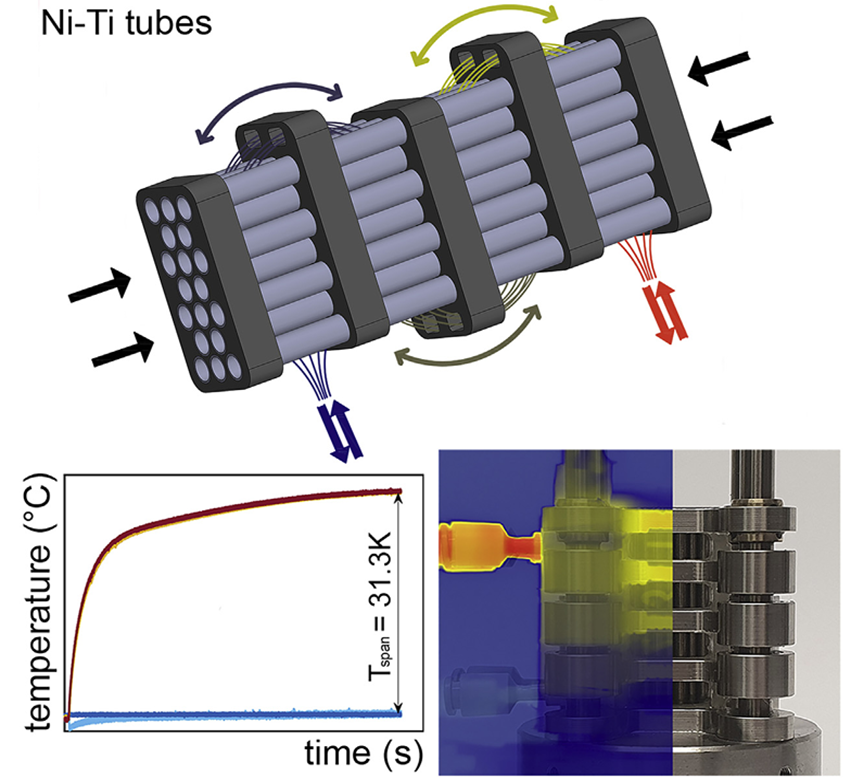
The coordinated system cycle
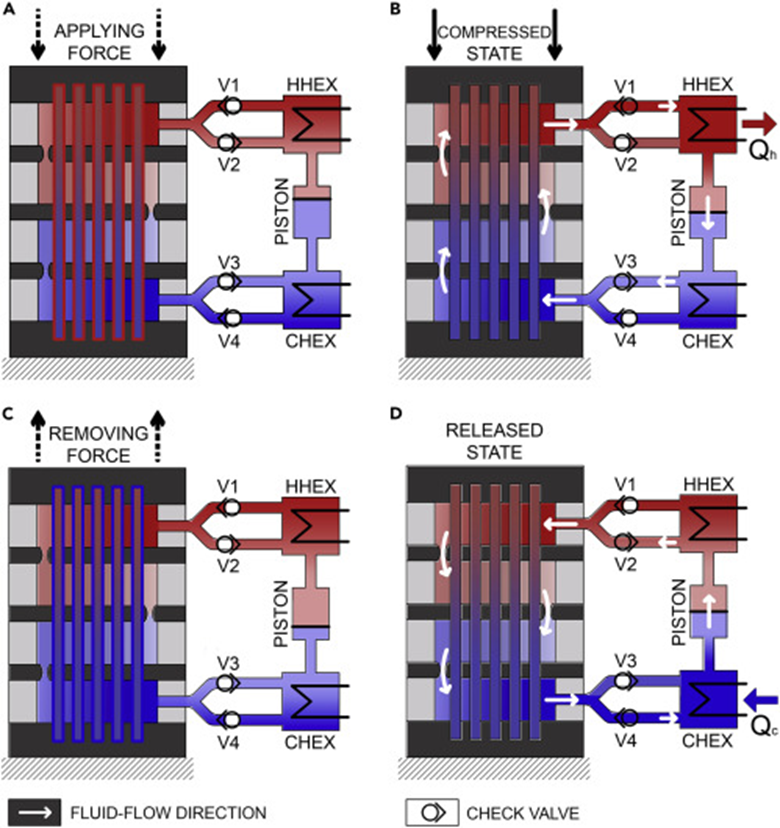
The solid metal produces the temperature change.
Heat exchange between the material and fluid builds and maintains the temperature span.
Timed mechanical loading and fluid flow carry heat from the cold side to the hot side. [1]
Our development combines thermal design, mechanical integrity, manufacturing know-how and experimental testing.
Cooling & heat pumping03 Experimental prototype TRL 4 · Laboratory scale
Our TRL 4 elastocaloric system brings active regenerators and a dedicated mechanical drive together in a laboratory-scale prototype.
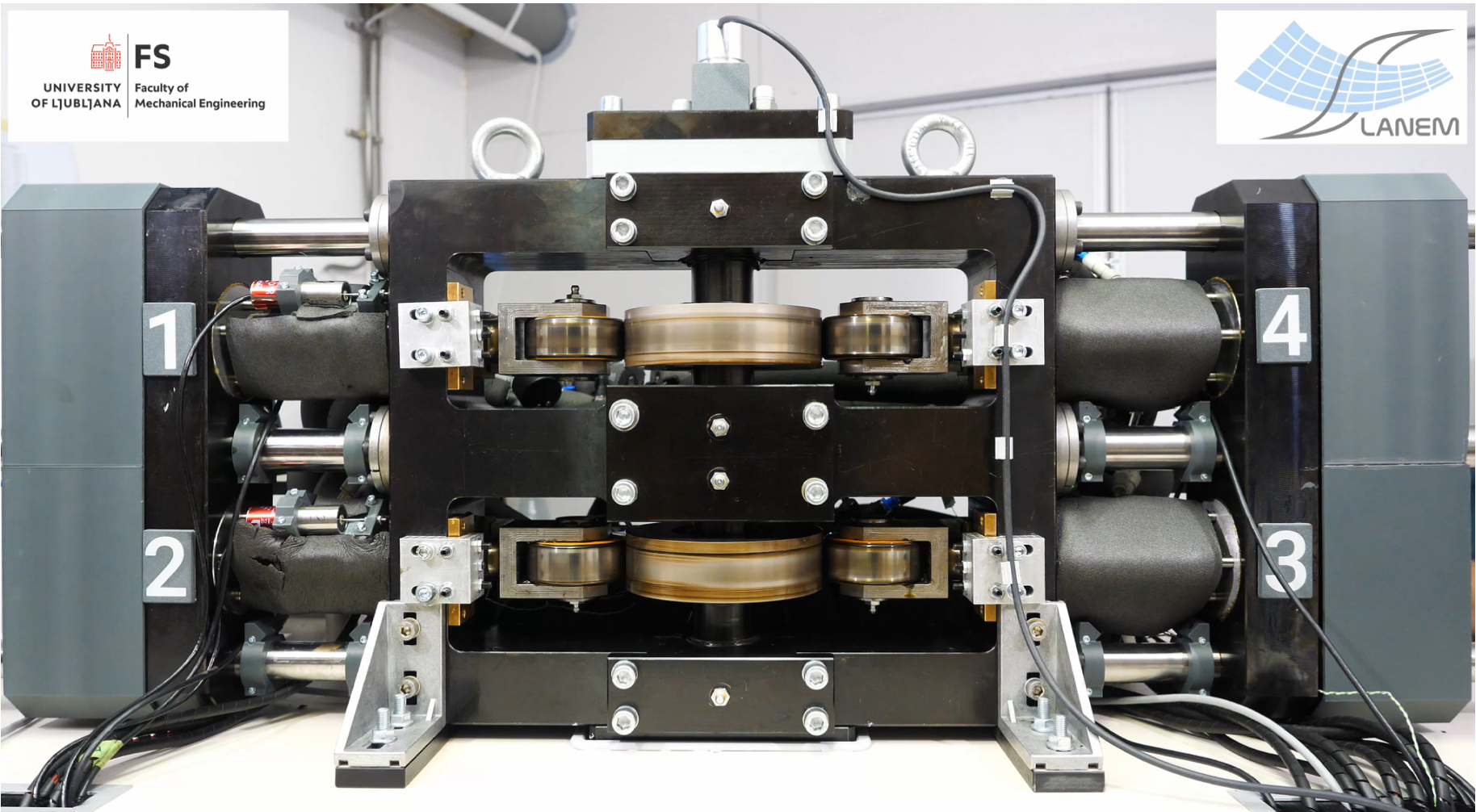
The drive controls the loading and unloading of the active regenerators. Matching its motion to their thermal cycle—and recovering mechanical work during unloading—is essential to reducing the system’s energy demand. [2]
The integrated prototype provides the starting point for the next stage: reducing size, improving efficiency and engineering the system for practical industrial use.
Read the drive-system research04 Product development In development
Our purpose is the industrialisation and commercialisation of elastocaloric cooling and heat pump technologies.
Two engineering priorities define that transition.
Reduce the overall module size towards dimensions comparable with vapour-compression systems at equivalent thermal duty and operating conditions.
Optimise the active regenerator, drive system, heat transfer and controls together to maximise useful cooling or heating per unit of electrical energy.
Our engineering scope
Active regeneratorsDrive systemsIntegrated thermal modulesDevelopment objectives: a compact system footprint and high efficiency at the intended operating conditions.
05 Team & founders
Our team brings together thermal engineering, mechanical design, numerical modelling and experimental validation.
Combines mechanical design, nonlinear mechanics and experimental engineering with industrial development experience. Leads company strategy, business development and industrial partnerships.
Engineering & commercial developmentBrings expertise in elastocaloric technology, heat transfer and active regeneration. Leads scientific and technology development, building on research in solid-state cooling and heat pumping.
Thermal science & technology developmentComplementary expertise connecting active regenerators, drive systems and complete thermal solutions.
06 Get in touch
Contact us to discuss the technology,
industrial collaboration or integration.